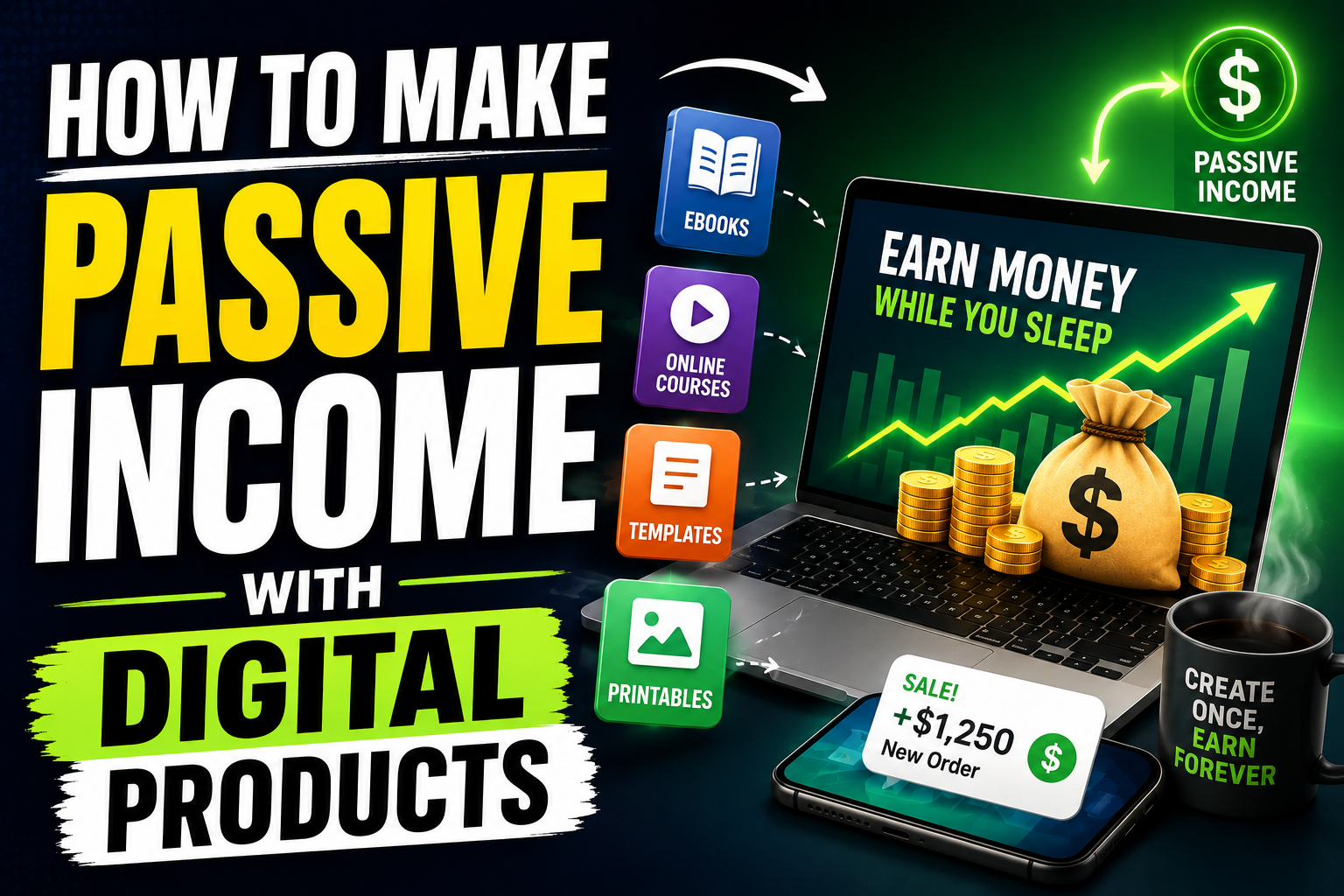
How to Make Passive Income With Digital Products
The Honest Beginner's Guide to Building Income That Works While You Sleep
Passive income.
Two words that get thrown around so much online that they've started to feel like a scam. Every other YouTube thumbnail promises you can make £5,000 a month doing nothing. Every other Instagram post shows someone on a beach checking their Stripe notifications.
And if you've been burned by the hype before — or you're just naturally sceptical — that's completely understandable.
So let's be straight with each other from the start.
Passive income with digital products is real. It works. People genuinely do earn money while they sleep. But the "passive" part comes after the work — not instead of it. There is an upfront investment of time and effort. Anyone telling you otherwise is trying to sell you something.
What makes digital products the most realistic path to passive income for a beginner with no budget is this — the upfront work is something you can do yourself, with free tools, starting this week. And once it's done, it genuinely does run on its own.
Let's break down exactly how.
What Passive Income With Digital Products Actually Looks Like
Here's the simplest possible explanation.
You create something once — an ebook, a template, a mini course, a prompt pack. You put it on a platform that handles payments and delivery automatically. Someone finds it, buys it, and downloads it — without you doing anything.
That transaction can happen at 3am on a Tuesday while you're asleep. It can happen ten times in one day while you're at work. It can happen six months after you created the product without you touching it again.
That's passive income. Not magic. Not a loophole. Just a system that works without your constant involvement.
The difference between this and a job is simple. A job pays you for your time. Digital products pay you for something you made. One stops the moment you stop showing up. The other keeps going.
Why Digital Products Are the Best Vehicle for Passive Income in 2026
There are other ways to earn passively — rental income, dividend investing, affiliate marketing. But most of them require either significant capital upfront or years of groundwork before they produce anything meaningful.
Digital products are different for four reasons.
Zero cost to create You don't need a factory, a supplier, or a warehouse. You need a laptop and free tools that already exist. Canva for design. Google Docs for writing. Loom for recording. All free.
Zero cost to deliver When someone buys your product, the platform delivers it automatically. No packaging, no postage, no fulfilment costs. Every sale is almost pure profit.
Unlimited inventory A physical product runs out of stock. A digital product never does. You could sell the same ebook to ten thousand people without creating a single additional copy.
It compounds over time The more products you create, the more income streams you have running simultaneously. Start with one ebook. Add a template pack. Add a mini course. Each one adds another layer of income that runs in the background.
The Honest Truth About the "Passive" Part
Before we get into the how, let's address the thing most guides skip.
Passive income is not immediate income. The passive part comes later. The first part is very much active.
You'll spend time creating your product. You'll spend time setting up your sales page. You'll spend time getting it in front of people. You'll probably tweak things that aren't working. You might not make a sale for the first few weeks.
That's normal. That's the process. The people who give up during this phase miss out on everything that comes after it — the moment when the system starts working and the sales come in without them doing anything new.
Think of it like planting a tree. You do the digging, the watering, the tending upfront. And then one day it just grows on its own. Nobody calls gardening passive — but nobody denies that a tree grows without you standing next to it every day.
Digital products work the same way.
Step-by-Step: How to Build Your First Passive Income Stream With Digital Products
Step 1 — Choose the Right Product to Start With
The biggest mistake beginners make is trying to start with something too complicated. A full online course with 20 video modules sounds impressive — but it takes months to build and can be overwhelming to someone who's never done this before.
Start smaller. Start with something you can finish.
The best first digital product for passive income is one that:
- Solves one specific problem for one specific type of person
- Can be created in a weekend or two
- Requires no specialist software to build
- Is something you genuinely know enough about to write or teach
The most beginner-friendly options are ebooks, guides, templates, and swipe files. Pick the format that suits what you know best.
A quick exercise — write down three things you know how to do that other people in your circle often ask you about. That list is your starting point. Any one of those could be a digital product.
Step 2 — Validate the Idea Before You Build It
This step saves you weeks of wasted effort.
Before you spend time creating anything, spend an hour checking whether people are actually looking for it.
Search your idea on Google. What comes up? Are there other products in this space? Are people asking questions about this topic on Reddit or Quora? If you search the topic and find nothing — no articles, no products, no questions — that's not a gap in the market. That's a sign there's no market.
You want to find evidence that people are already looking for a solution to the problem your product solves. Competition is a good sign, not a bad one. It means there's demand.
The sweet spot is a topic with clear demand but where the existing answers are vague, outdated, or aimed at people with bigger budgets than your audience has. That's your opening.
Step 3 — Create It With Free Tools
Here's a full breakdown of what to use depending on your product type.
Ebook or guide: Write it in Google Docs. Design the cover and layout in Canva — they have free ebook templates that look genuinely professional. Export as PDF. Done.
Template: Build it in Canva, Google Sheets, or Notion. Export or share the link in a way the buyer can duplicate and use.
Mini course: Record short video modules using Loom — free, simple, no editing required. Write a short accompanying PDF. Package both together.
Prompt pack or swipe file: Write and organise in Google Docs or Notion. Format it cleanly, give it a clear structure, export as PDF.
None of this requires Photoshop, Final Cut Pro, or any paid software. The quality of a digital product is judged on the usefulness of its content — not the production budget behind it.
Step 4 — Set Up Your Sales System — For Free
This is the part that used to be complicated and expensive. Not anymore.
To sell a digital product passively you need three things:
- Somewhere to host and deliver the product
- A way to take payments automatically
- Optionally — a landing page to explain what the product is and why someone should buy it
A few years ago you'd have needed three separate tools for this — a file hosting service, a payment processor, and a landing page builder. Each with its own monthly subscription.
Today there are platforms that handle all three in one place, completely free, with no monthly fee and no transaction percentage on the free plan.
You upload your product. You set your price. You get a link. Someone clicks that link, pays, and the product is delivered to them automatically. You don't have to do anything.
That automation is what makes it passive. Once it's set up, it runs without you.
Set up your free digital product store right here
Step 5 — Write a Sales Page That Does the Selling For You
Your sales page is your 24/7 salesperson. It has to work while you're not there — answering questions, building trust, and convincing the right person to buy.
A good beginner sales page doesn't need to be long or fancy. It needs five things:
A headline that names the problem or the outcome. Not "my ebook" — but "How to build your first sales funnel without spending a penny."
A short description of who it's for and what they'll get. Be specific. "This is for complete beginners who want to start making money online but have no budget and no tech skills."
A list of what's inside. Bullet points. Clear and concrete. Not vague promises — actual content.
Some social proof if you have it. A testimonial, a result, even a quote from someone who read it. If you have none yet, skip this and add it later.
A clear buy button. One call to action. Make it obvious.
That's it. No copywriting degree required.
Step 6 — Get It In Front of People Without Paid Ads
Here's the question everyone eventually asks. "How do I actually get people to find it?"
The good news — you don't need a social media following or an advertising budget to make your first sales. You need to be in the places where your potential buyers already are.
Write blog content around the topic your product solves. If your ebook is about starting a side hustle with no money, write articles about side hustles, passive income, and making money online. People find the articles through Google, read them, and click through to your product. This is the long game — but it builds traffic that compounds over time.
Answer questions on Reddit and Quora. Find the subreddits and question threads where your audience is asking exactly the problem your product solves. Give a genuinely helpful answer. Mention your product naturally at the end where it's relevant.
Post in Facebook groups. There are thousands of groups for people interested in side hustles, making money online, digital products, and solopreneurship. Engage genuinely. Help people. When the moment is right, mention what you've created.
Use your product as a content asset. Share a page, a tip, or a section from your product as a free sample. Give people a taste of what's inside. The best marketing for a digital product is the product itself.
None of these cost money. All of them work.
Step 7 — Let the System Run and Then Improve It
Once everything is set up — product created, sales page live, traffic coming in — your job shifts from building to improving.
Check what's working. How many people visit your sales page versus how many buy? If lots of people are landing but not buying, your sales page needs work. If very few people are landing, your traffic strategy needs work.
Add a second product. Create a bundle. Lower the price to test whether it converts better. Add a new traffic source.
Each improvement compounds. Each new product adds another passive income stream. Over time, the system becomes genuinely self-sustaining — bringing in income consistently without requiring your constant attention.
That's the real passive income goal. Not one lucky sale. A system that works.
Real Talk — How Long Does This Take?
Honestly? Your first sale could come within days of publishing your product if you're active in the right communities. Or it could take a few weeks.
Building consistent passive income — the kind where money comes in regularly without you doing much — typically takes three to six months of consistent effort upfront. Writing content, building traffic, refining your products, adding new ones.
That's not a long time in the grand scheme of things. And unlike a job, every hour you put in during that period keeps paying you back long after you've moved on to something else.
FAQ
Can I really make passive income with no audience and no money? Yes — but manage your expectations. You won't make thousands in your first month. You might make your first £10 or £20 and it will feel small. But that first sale proves the model works. Build from there.
Do I need my own website to sell digital products? No. There are free all-in-one platforms that give you a sales page, payment processing, and product delivery without needing a website. You can be set up and selling within a day.
What if my product doesn't sell? Don't delete it. Diagnose it. Is the title clear? Does the sales page explain the value? Are the right people seeing it? Usually the product is fine — it's the visibility or the messaging that needs tweaking. Small changes can make a big difference.
How much should I charge? For a first digital product, somewhere between £5 and £27 is a good starting range. Enough to feel like real value, low enough to be an easy purchase decision. You can always raise the price later once you have reviews and proof that it works.
Is this a get rich quick scheme? No. And anyone positioning it that way is misleading you. It's a genuine business model that requires real work upfront. The passive part is real — but it comes after the effort, not instead of it.
The Bottom Line
Passive income with digital products is one of the most realistic ways for a complete beginner to build an online income in 2026 — precisely because the barriers have never been lower.
The tools to create are free. The platforms to sell on are free. The knowledge to get started is right here.
What it requires is this — you have to actually start. Pick a product idea. Create it. Set up your store. Get it in front of people. Then keep going when the first week is quiet.
The people making consistent passive income from digital products aren't smarter than you or more talented than you. They just started — and they didn't stop.
Ready to build your first passive income stream? Set up your free store here