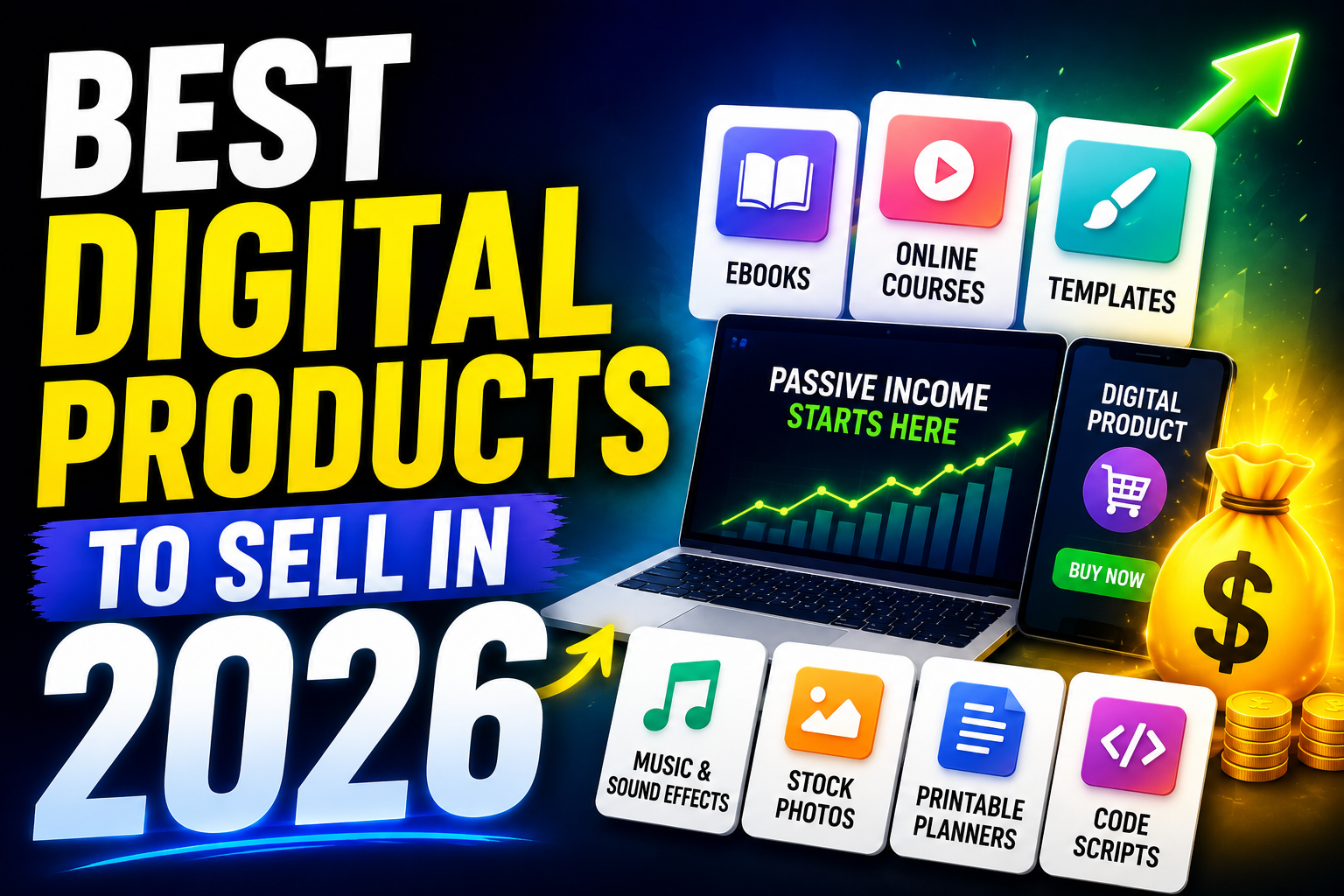
Best Digital Products to Sell in 2026
What's Actually Working Right Now — and How to Start With Zero Budget
Let's start with the thing nobody tells you when you first Google this topic.
You'll land on lists. Lots of them. "47 digital product ideas!" "The top 100 things to sell online!" And you'll read through them feeling equal parts excited and completely overwhelmed — because nobody explains which ones are realistic for a beginner, which ones take months to build, and which ones you could genuinely start this week with no money and no audience.
That's what this article is for.
We're going to go through the best digital products to sell in 2026 — honestly, simply, and with a clear eye on what actually makes sense if you're starting from scratch.
First — Why Digital Products at All?
Before the list, let's make sure we're on the same page about why this matters.
Digital products are files or content that someone buys and downloads. An ebook. A template. A course. A checklist. A pack of presets.
No physical stock. No packaging. No shipping. No manufacturing costs. You create it once and sell it an unlimited number of times.
That last part is the bit worth sitting with for a moment.
You do the work once. Then it sells while you sleep, while you're at work, while you're watching TV. Every sale is almost pure profit because your costs after creation are essentially zero.
In 2026 the digital product market is enormous — online courses alone are a $200 billion global industry. And the barrier to entry has never been lower. The tools to create, host, and sell a digital product are available completely free. There is genuinely no good reason to wait.
The Best Digital Products to Sell in 2026
1. Ebooks and Guides
This is the most beginner-friendly digital product that exists — and it's still one of the best sellers in 2026.
An ebook doesn't have to be a novel. It doesn't have to be 200 pages. Some of the best-selling ebooks online are 20–30 pages of genuinely useful, well-organised information on a specific topic someone really wants to learn about.
The key word there is specific. "How to lose weight" is too broad and too competitive. "How to lose weight on a budget using meal prep" is a product. "How to start freelancing as a graphic designer with no portfolio" is a product. The more specific the problem you're solving, the more valuable your guide becomes.
What you need to create one: A Google Doc or Canva. That's it. Write what you know, design it simply, export as a PDF.
What you need to sell one: A free platform that lets you upload a file and take payments. More on that shortly.
Who buys them: People who want a shortcut. Someone who wants the answer without having to spend hours piecing it together from YouTube videos and blog posts. That's a very large number of people.
2. Templates
Templates are one of the fastest growing digital product categories right now — and for good reason. People are time-poor and the idea of buying something that's already done for them, that they just customise, is extremely appealing.
What kind of templates sell well in 2026?
- Social media post templates in Canva
- Email sequence templates for small business owners
- Budget spreadsheet templates
- Content calendar templates
- CV and resume templates
- Business plan templates
Notice something about that list. None of them require specialist skills to create. If you've ever made a spreadsheet you're proud of, a Canva design that looks clean, or a system that keeps you organised — that is a template someone will pay for.
The golden rule with templates: Solve one specific, recurring problem. A "social media template pack for fitness coaches" will outsell a generic "social media template pack" every single time.
3. Online Courses and Mini Courses
Before you scroll past this one thinking it's not for you — hear me out.
A full blown online course with video modules, a community, and a certificate is one option. But in 2026 the mini course has become arguably more popular and more profitable for beginners.
A mini course is a short, focused, outcome-based product. Three to five modules. Each one maybe 10–15 minutes. A clear promise: by the end of this you will know how to do X.
People pay for these because they're digestible. Nobody has time for a 40-hour course on a topic they're not sure about yet. But a two-hour mini course that teaches them one specific skill? That's an easy yes.
What sells well as a mini course right now:
- How to use AI tools for your business
- How to set up a sales funnel from scratch
- How to start freelancing in a specific niche
- How to create and sell your first digital product
That last one is particularly interesting — teaching what you're learning as you learn it is a completely valid and often very relatable approach for a beginner creator.
4. Printables
Printables are digital files people download and print at home. Planners, journals, habit trackers, budget sheets, wall art, kids activity sheets, meal planners.
This category lives largely on Etsy and Pinterest — but the profit margins are extraordinary. You create a PDF once in Canva, and it sells indefinitely with zero ongoing work.
The market for printables is huge and genuinely evergreen. People always want to get organised, track their habits, plan their week, decorate their home on a budget.
Best for: People who enjoy design and organisation. If you can use Canva you can create printables.
Watch out for: The market is competitive, so specificity matters. A generic "daily planner" is hard to sell. A "daily planner for work-from-home parents" with a layout designed around school hours is a product with a clear audience.
5. AI Prompt Packs
This is the newest category on the list and one of the fastest growing in 2026.
As AI tools like ChatGPT and Midjourney have become mainstream, millions of people use them every day — but most don't really know how to get great results from them. Writing a prompt that gets a genuinely useful, high-quality output is a skill. And people will pay for that skill packaged up neatly.
An AI prompt pack is simply a collection of tested, optimised prompts for a specific use case. Prompts for writing social media captions. Prompts for creating a business plan. Prompts for designing images in a specific style. Prompts for writing cold emails.
What you need to create one: Time and experimentation. Test prompts, refine them, package the ones that work into a simple PDF or Notion document.
Why it works: You're selling saved time and expertise. The buyer doesn't have to spend hours figuring out what you've already figured out.
6. Swipe Files and Resource Packs
A swipe file is a curated collection of examples, scripts, or resources someone can reference and adapt. Think:
- 50 proven email subject lines that get opened
- 30 social media caption templates for coaches
- 20 sales page headlines that convert
- A collection of the best landing page examples broken down by what makes them work
These are quick to create, genuinely useful, and solve a very specific problem — the blank page problem. Most people know what they need to write. They just don't know how to start. A swipe file removes that friction entirely.
What Do All the Best-Selling Digital Products Have in Common?
Look back at everything on that list and you'll notice a pattern.
Every single one solves a specific problem for a specific person. None of them are vague. None of them try to appeal to everyone.
The beginner mistake is to create something broad hoping to reach more people. The reality is the opposite — the more specific your product, the more valuable it feels, and the more willing people are to pay for it.
The question to ask before you create anything: "Who exactly is this for, and what exact problem does it solve?" If you can't answer that in one sentence, narrow it down until you can.
How to Actually Start — Without Spending Anything
Here's the practical bit.
Step 1 — Pick one idea from this list Don't try to create five products at once. Pick the one that best matches what you already know, and start there.
Step 2 — Validate it before you build it Google your idea. Search it on Etsy. Look on Reddit. Are people asking questions about this topic? Are other products in this space selling? If yes, there's a market. If you can find zero competition anywhere, that's usually a warning sign, not an opportunity.
Step 3 — Create it with free tools Ebook or guide? Google Docs and Canva. Template? Canva or Google Sheets. Mini course? Loom for screen recording, free and simple. Prompt pack? A well-formatted Google Doc or Notion page exported as PDF. None of this requires paid software.
Step 4 — Set up a place to sell it for free This is where most beginners get stuck — they think they need a website, a payment processor, an email tool, and a hosting platform all separately. You don't. There are platforms that handle all of this in one place, completely free, with no monthly fee and no credit card required.
You upload your product, set your price, and the platform handles the checkout, the delivery, and the payment. Your job is just to send people there.
Start selling your first digital product for free right here
Step 5 — Tell people it exists Write a blog post about the problem your product solves. Answer questions on Reddit and mention it where relevant. Share it in Facebook groups where your audience hangs out. You don't need paid ads or a huge following to make your first sale — you need to put it in front of the right people.
FAQ
Do I need a big following to sell digital products? No. Plenty of people make their first digital product sale with zero social media following. What you need is a way to get it in front of people who have the problem it solves — and there are free ways to do that.
How much should I charge for my first digital product? For a beginner, somewhere between £5 and £27 is a comfortable starting range for most digital products. Price it low enough to be an easy yes, but high enough that it feels like it has real value. A free product feels throwaway. A £7 ebook feels like a worthwhile purchase.
How long does it take to create a digital product? An ebook or template can be created in a weekend. A mini course might take two to four weeks if you're doing it alongside other commitments. The point is — none of this requires months of preparation. Start with something simple, get it out there, and improve it based on feedback.
What if nobody buys it? This happens and it's not the end. It usually means one of three things — the wrong audience saw it, the problem wasn't specific enough, or the title didn't communicate the value clearly. All of those are fixable without starting from scratch.
The Bottom Line
The best digital product to sell in 2026 is the one you actually create and put out into the world.
This list isn't missing anything exotic or secret. Ebooks, templates, mini courses, printables, prompt packs, swipe files — these are the products generating real income for real people right now, many of whom started with no audience, no budget, and no prior experience.
The tools to create them are free. The platforms to sell them are free. The only thing standing between you and your first digital product sale is the decision to start.
Ready to set up your digital product store for free? Start here